

Writing
At Frinton on Sea Primary School, our children will learn about the elements on the National Curriculum to ensure they are confident in all areas of the writing strand in line with the end of Key Stage 2 expectations.
Our genre coverage is based on high-quality texts from different authors and cultures allowing a wide variety of genres in fiction, non-fiction and poetry to be taught.
To support the children with their writing skills, various scaffolding and learning resources are used such as word banks, videos, picture prompts, pre-populated planning sheets, sound buttons, the use of technology and cut up sentences.
Writing Composition
At Frinton Primary School, we teach writing composition using a clear writing process (adapted from the Education Endowment Foundation).
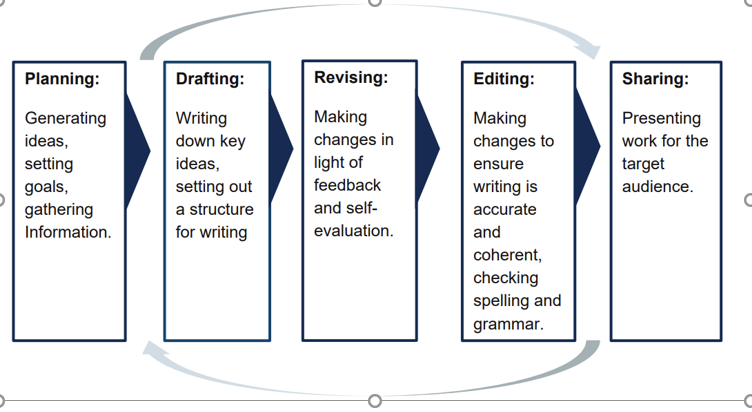
Children’s writing is usually linked to their learning contexts or to books from our school’s core reading spine (the latter includes fiction, non-fiction, poetry and plays); for example, children in Year 6 may write war poetry, linked to their reading of World War I poetry, which is then displayed at the local branch of the Royal British Legion.
In EYFS, Y1 and Y2 the focus is on learning the foundations of writing composition, especially the basic rules of sentence structure, grammar and punctuation. There is an emphasis on oral retelling of texts and oral rehearsal of what they want to write. With these key skills in place, children in Key Stage 2 can write progressively more complex texts across a variety of genres and for a variety of purposes. Across all year groups, there is an emphasis on clear teacher-modelling of writing and the use of quality exemplar texts.
Grammar, Punctuation and Spelling
In EYFS and Y1, spelling is taught through daily phonics sessions and is reinforced in handwriting lessons. In Y2-Y6, children follow the ‘Spelling Shed’ scheme, which includes opportunities for online practice at home.
Grammar and punctuation are taught and reinforced as a part of the writing composition process, meaning that children have opportunities to practise and apply their skills in a meaningful way.
Handwriting
In EYFS, children are given many intentional opportunities to develop their fine motor skills, in preparation for handwriting. Early in the autumn term, they begin the school’s phonics programme and learn to form letters and ‘tricky’ words as they progress through the programme. Children practise their skills regularly and the expectation is that they will be forming both upper- and lower-case letters correctly in readiness for their learning in Y1.
Children in Y1-Y6 follow the ‘Letter-join’ Handwriting Programme. This progressive programme introduces joined handwriting in Y2, the expectation being that children can write clearly, effectively and fluently as they enter KS2.
english writing intent doc .pdf